
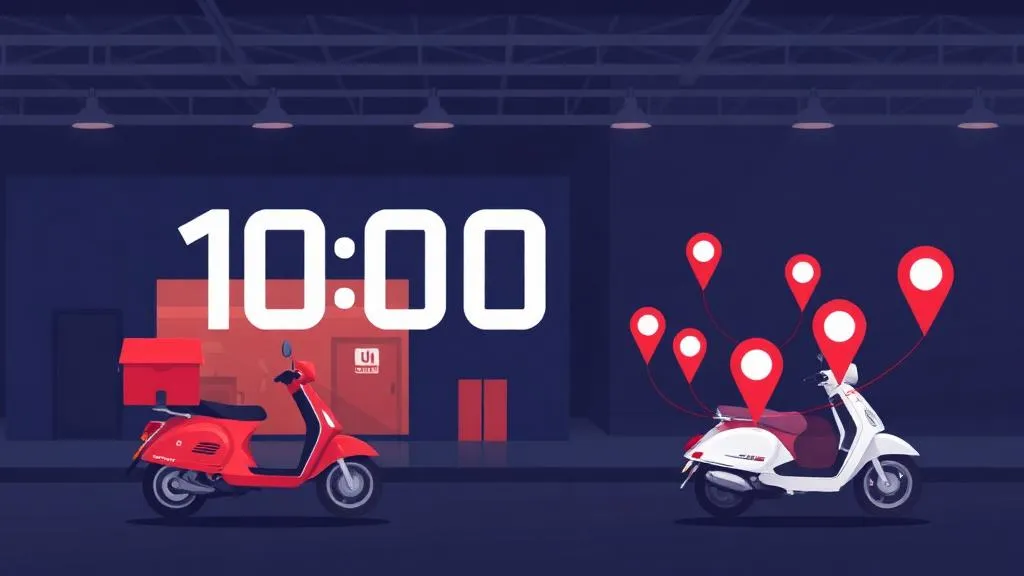
Quick commerce (q-commerce)
— the delivery of products in 10–30 minutes — has exploded from a niche experiment into a mainstream consumer expectation. Platforms like Blinkit, Zepto, Swiggy Instamart, BigBasket Now, and international players like Getir and Gopuff have fundamentally changed how consumers buy everyday products. For brands and retailers, this shift demands an entirely new marketing playbook.
What makes quick commerce different
Traditional e-commerce is planned — consumers browse, compare, and decide over hours or days. Quick commerce is impulse-driven — consumers want something now, and they want it delivered in minutes. This changes everything about how you market: product discovery happens on the app, not Google. Purchase decisions are made in seconds, not days. Price sensitivity is lower (convenience premium). Repeat purchase rates are extremely high for FMCG and essentials.
Dark store marketing strategies
Dark stores — fulfilment-only micro-warehouses — are the backbone of quick commerce. Marketing for dark store operations focuses on: hyperlocal targeting (ads served only to consumers within 2–5 km of your dark store), inventory-led promotions (promoting products based on real-time stock levels and expiry dates), weather and time-based marketing (promoting ice cream during heat waves, coffee during mornings, snacks during cricket matches), and bundle deals that increase average order value.
Platform-specific marketing on Blinkit, Zepto & Swiggy Instamart
Each q-commerce platform offers advertising and promotional tools for brands: Sponsored listings (boosted product placement in search results and category pages), Banner ads (homepage and category-level visibility), Brand stores (curated pages for your product range), Sampling campaigns (free product inclusion in orders to drive trial), and Combo offers (buy X get Y deals that drive basket size).
Hyperlocal marketing beyond the platforms
To drive demand to your q-commerce listings, invest in hyperlocal digital marketing: Geo-targeted social ads on Instagram and Facebook targeting specific pin codes and neighbourhoods. Google Local Service Ads for service-based businesses. WhatsApp marketing with location-based offers and reorder reminders. Community partnerships with local events, societies, and neighbourhood groups.
FMCG digital marketing for quick commerce
For FMCG brands, quick commerce represents a massive channel shift. Key strategies include: New product launches exclusively on q-commerce platforms (creates buzz and urgency), Festive and seasonal campaigns tied to delivery speed, Subscription and auto-replenishment features for staples like milk, bread, and household essentials, and Data-driven assortment — using platform analytics to understand which products sell best in which locations.
Measuring q-commerce marketing performance
Key metrics for quick commerce marketing include: Cost per acquisition (CPA) by platform and geography, Return on ad spend (ROAS) for platform-specific ads, Repeat purchase rate and customer lifetime value, Share of search on platform, Delivery conversion rate, and Dark store-level performance.
How HowAutomate helps with quick commerce marketing
We help brands and D2C businesses build their q-commerce marketing strategy: platform onboarding and optimisation, hyperlocal ad campaigns, product listing optimisation, performance dashboards with real-time data from Blinkit/Zepto/Swiggy APIs, and automated inventory-led marketing triggers.
Frequently asked questions
What is quick commerce and how is it different from traditional e-commerce?
Quick commerce (q-commerce) is hyperlocal retail delivery within 10–30 minutes, fulfilled from neighbourhood dark stores or partner retail outlets. Unlike traditional e-commerce (1–5 day delivery from central warehouses), q-commerce serves impulse and urgent purchases — groceries, snacks, personal care, baby supplies, medicines. The major platforms in India are Blinkit (Zomato), Zepto, Swiggy Instamart, and BigBasket Now. Success in q-commerce requires dark store proximity to customers, real-time inventory accuracy, and SKU selection optimised for impulse purchase categories.
How do I get my brand listed on Blinkit, Zepto, or Swiggy Instamart?
Each platform has a brand/supplier onboarding portal. For Blinkit, apply at the Blinkit Seller Portal with your FSSAI licence (for food), GST registration, and brand authorisation documents. Zepto and Swiggy Instamart have similar processes. Listing approval takes 2–6 weeks. Key requirements: product must meet minimum shelf life criteria (typically 60+ days remaining), packaging must display required regulatory information, and you must be able to supply to local dark store locations. Most platforms also require minimum order quantities and offer improved shelf placement for brands agreeing to in-app promotional commitments.
What is a dark store in quick commerce?
A dark store is a small-format retail warehouse (typically 1,500–4,000 sq ft) located in residential neighbourhoods, stocked exclusively for fast delivery — not open to walk-in customers. Dark stores stock 2,000–5,000 high-velocity SKUs optimised for the local area's purchase patterns. They are the physical backbone of quick commerce: Blinkit operates 600+ dark stores across India; Zepto has 350+. For brands, getting listed in dark stores within a specific PIN code is the hyperlocal SEO equivalent — the closer to your target customer, the higher your visibility and delivery promise.
What marketing tactics work best on quick commerce platforms?
The highest-ROI q-commerce marketing tactics are: (1) in-app sponsored listings — bid for top placement when shoppers search your category; (2) banner ads at category entry pages — brand awareness at the moment of browse; (3) sampling and combo offers — bundle a new product with a bestseller to drive trial; (4) flash sales and happy hour discounts — q-commerce shoppers are deal-responsive; (5) stock availability management — being in-stock consistently improves organic ranking on all platforms. Unlike traditional e-commerce, q-commerce consumers buy based on immediate availability more than brand loyalty, so pricing and positioning matter more than content.
What is hyperlocal marketing and how does it help q-commerce brands?
Hyperlocal marketing targets consumers within a defined geographic radius — typically 1–5 km from a dark store or delivery hub. For q-commerce brands, hyperlocal marketing includes: geofenced Meta and Google Ads targeting PIN codes served by dark stores stocking your product; local influencer partnerships with creators based in high-density urban areas; neighbourhood-specific offers (e.g., 'free delivery in Koramangala this weekend'); and WhatsApp broadcast lists segmented by locality. Hyperlocal targeting improves campaign efficiency by focusing spend only on areas where your products are actually available for 10–30 minute delivery.

Amit has 6+ years of experience building data pipelines, AI agents, and automation systems for businesses across India and globally. He founded HowAutomate to make enterprise-grade automation accessible to growing businesses.