
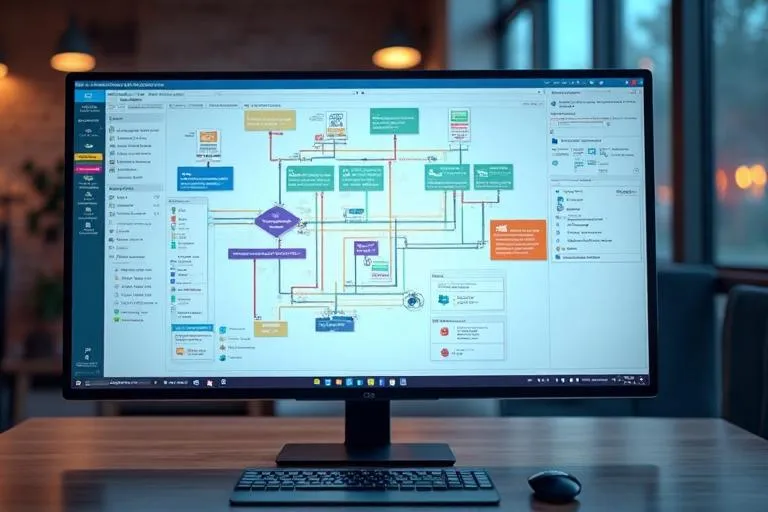
SnapLogic is an enterprise Integration Platform as a Service (iPaaS) that enables organisations to connect applications, data sources, and APIs through a visual, low-code pipeline builder. It's used by hundreds of large enterprises to automate data movement and business process integration at scale.
What makes SnapLogic different
The platform's core building blocks are called 'Snaps' — pre-built connectors for specific applications and protocols. There are over 700 Snaps available, covering everything from Salesforce and SAP to AWS S3 and REST APIs. You connect Snaps into visual pipelines, configure their settings, and SnapLogic handles the execution, scaling, and monitoring.
Common SnapLogic use cases
ERP integration (connecting SAP or Oracle to downstream systems). Data warehouse population (moving data from operational systems into Snowflake or Redshift). B2B data exchange (EDI, API-to-API integrations with partners). Application modernisation (replacing custom point-to-point integrations with managed pipelines).
Who should use SnapLogic
SnapLogic is best suited for large enterprises with complex integration landscapes — many different systems, large data volumes, and strict governance requirements. For smaller organisations or simpler use cases, lighter-weight tools like Make.com, n8n, or custom Python pipelines are typically more cost-effective.
Implementation considerations
SnapLogic requires experienced practitioners to get the most out of it. The visual interface is approachable, but production-grade pipelines require knowledge of error handling patterns, data type management, performance optimisation, and monitoring setup. At HowAutomate, we have certified SnapLogic practitioners who deliver enterprise implementations efficiently.
SnapLogic vs other iPaaS platforms
Versus MuleSoft: SnapLogic is typically easier to deploy and less expensive, while MuleSoft offers deeper API management capabilities. Versus Informatica: both are enterprise-grade platforms, but Informatica has a longer track record in data warehousing specifically. Versus Azure Data Factory / AWS Glue: cloud-native tools are significantly cheaper but require more custom development. SnapLogic sits in the middle — lower TCO than MuleSoft/Informatica, higher capability than cloud-native DIY tools for complex multi-system landscapes.
SnapLogic architecture: how pipelines work
SnapLogic pipelines consist of a source Snap, zero or more transformation Snaps, and a target Snap. Data flows as a stream of JSON documents. Each Snap can transform, filter, split, or aggregate the stream. Ultra Pipelines enable real-time data processing with sub-second latency, while standard pipelines run in batch mode on a schedule. SnapLogic's Groundplex (on-premise execution engine) allows pipelines to run within your firewall for data residency and compliance requirements.
Error handling and monitoring in production
Use the Try/Catch Snap to handle exceptions gracefully — routing failed records to an error queue rather than stopping the entire pipeline. The SnapLogic Manager console provides real-time monitoring of running pipelines, execution logs, and historical run statistics. Integrate with your existing monitoring stack (PagerDuty, Slack, email) via SnapLogic's built-in alerting and the REST Snap for custom notifications on failures or SLA breaches.
Typical implementation timeline
A standard SnapLogic implementation: Discovery (Weeks 1–2) — map source systems, target schema, and business rules. Design (Weeks 3–4) — architect pipeline structure and error handling strategy. Development (Weeks 5–8) — build and test in the development environment. UAT (Weeks 9–10) — user acceptance testing with real data volumes. Production go-live (Weeks 11–12) — deploy with parallel run validation. Complex implementations with 20+ source systems may run 4–6 months.
SnapLogic's cost model
SnapLogic is sold on a subscription basis with pricing based on capacity units (CUs) — the compute resources consumed by pipeline execution. A medium-complexity enterprise integration project typically runs $50,000–$200,000 per year depending on data volumes and pipeline complexity. Evaluate total cost of ownership against the alternative: the cost of custom-built integrations maintained by your own engineering team. For enterprises evaluating SnapLogic, HowAutomate provides proof-of-concept development so you can validate the platform against your specific use cases before signing a multi-year contract.
Frequently asked questions
What is SnapLogic used for?
SnapLogic is a cloud-native integration platform (iPaaS) used to connect enterprise applications, databases, and APIs without custom coding. It is most commonly used for ERP integrations (SAP, Oracle, Workday), data pipeline automation, and API management in mid-to-large enterprises. Its visual Snap designer lets non-developers build integrations using pre-built connectors — called Snaps — for hundreds of platforms.
What is a 'Snap' in SnapLogic?
A Snap is SnapLogic's term for a pre-built connector or transformation component. Each Snap handles a specific function — reading from Salesforce, transforming a CSV, writing to a SQL database, calling a REST API. You connect Snaps in a Pipeline (SnapLogic's term for a workflow) using a visual drag-and-drop canvas. SnapLogic ships over 700 pre-built Snaps, covering almost every enterprise application in common use.
How does SnapLogic compare to MuleSoft?
MuleSoft (now owned by Salesforce) and SnapLogic target the same enterprise integration market. MuleSoft has a stronger API management layer and deeper Salesforce ecosystem integration. SnapLogic is generally faster to implement, has a more intuitive UI, and is competitively priced for mid-market enterprises. MuleSoft dominates in large enterprise accounts; SnapLogic wins where speed-to-value and visual development are priorities. Both are significantly more expensive than open-source alternatives like Apache Camel or n8n.
How much does SnapLogic cost?
SnapLogic pricing is not publicly listed and is negotiated per contract. Typical enterprise agreements start at $50,000–$150,000/year depending on the number of pipelines, users, and data volume. A basic department-level implementation typically costs $20,000–$60,000 in professional services on top of licensing. For SMBs, SnapLogic is usually overkill — n8n, Make, or Azure Data Factory offer 80% of the functionality at a fraction of the cost.
Can SnapLogic replace custom ETL development?
For standard integration patterns — connecting CRMs, ERPs, databases, and SaaS apps — SnapLogic can replace custom ETL development entirely. It handles scheduling, error handling, data transformation, and monitoring out of the box. Custom development is still needed for highly specialised transformations, proprietary data formats, or ultra-high-throughput streaming pipelines where SnapLogic's per-document pricing becomes prohibitive. The typical build time for a SnapLogic integration is 2–5× faster than equivalent custom code.

Amit has 6+ years of experience building data pipelines, AI agents, and automation systems for businesses across India and globally. He founded HowAutomate to make enterprise-grade automation accessible to growing businesses.